

by Alex Baumhardt, Washington State Standard
October 28, 2026
Six western states, including Oregon, have lost more than one-third of their glacial cover since 1950 and more than 300 glaciers in those states have disappeared entirely as the earth has rapidly warmed, a first-of-its-kind inventory and analysis confirms.
Researchers at Portland State University and the U.S. Geological Survey built their findings on an earlier analysis that looked at the lost area and volume among 612 federally recognized glaciers in California, Colorado, Idaho, Montana, Oregon, Washington and Wyoming since 1950.
In that analysis, they found that 50 are no longer considered glaciers given their size and condition, including 25 in the Cascade Range and seven in Oregon. Geologists consider glaciers to cover at least 25 acres. And they found two federally recognized glaciers in Washington and Wyoming disappeared entirely.
Their latest study, recently published in the journal of the National Academy of Sciences, looks at size and volume data from 1,331 Western glaciers, not all federally recognized. It compares that data to historical USGS glacial mapping data recorded between 1950 and 1980.
In the 1950s, there were more than 1,450 glaciers across the West. Nearly one-quarter of the glaciers recorded in the mid 20th century are now gone, the researchers found.
The total glacier area in the West has shrunk by 35%, and volume has shrunk by 33%. The lost volume, if averaged across all remaining glaciers, would be equivalent to each of them dropping by 38 feet, according to Andrew Fountain, a Portland State University geology professor who led the study.
“These glacier losses are tangible evidence of continued climate warming,” Fountain said in an email.
Global average temperatures have risen 2 degrees Fahrenheit since the 1850s due to humans burning fossil fuels that emit planet-warming greenhouse gases that get trapped in earth’s atmosphere.
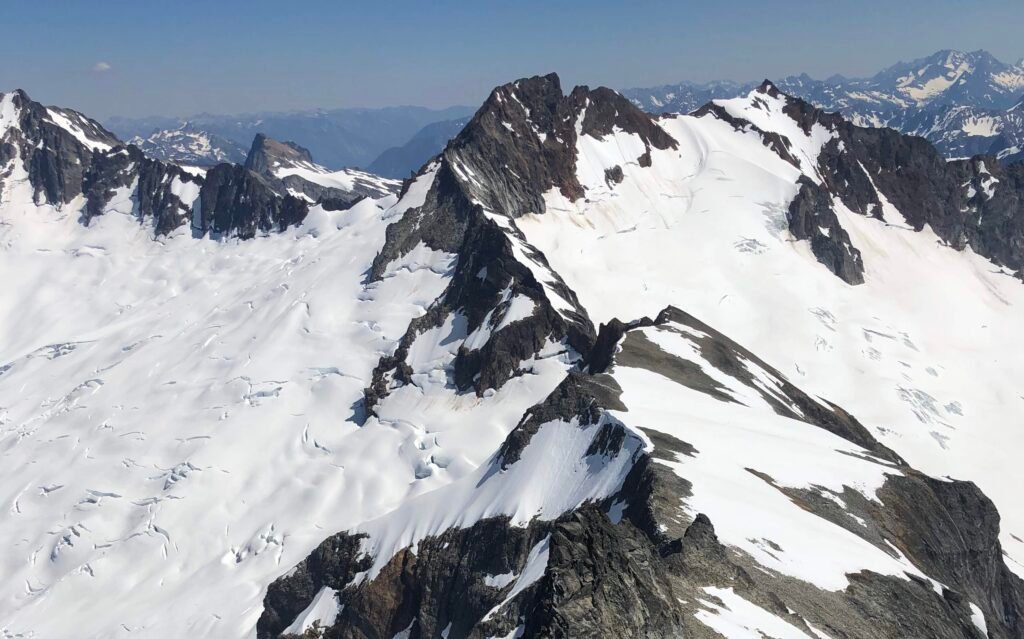
Most of the West’s glaciers are in Washington state, and the glacial cover on Mount Rainier alone is larger than that of all the other states combined. Among the lower 48 states, Washington is home to 89% of the country’s total volume of glaciers, but the Cascade range glaciers in Washington and Oregon have lost 13% of their volume in the last several decades. The Sierra Nevada mountains in California have lost 77% of their glacial volume.
Snowpack in the Northwest and in the Cascade Range, which acts as a reservoir during the summer months when there’s little rain and many communities rely on snowmelt, is sitting at some of the lowest levels since record-keeping began in 1985.
“Smaller glaciers mean less flow of cold water to high alpine streams and riparian habitat, a critical source in the hot dry climate of late summer,” Fountain said.
And last year, the region experienced its warmest fall on record, according to National Oceanic and Atmospheric Administration data.
This story was originally produced by Oregon Capital Chronicle, which is part of States Newsroom, a nonprofit news network which includes Washington State Standard, and is supported by grants and a coalition of donors as a 501c(3) public charity.
Washington State Standard is part of States Newsroom, a nonprofit news network supported by grants and a coalition of donors as a 501c(3) public charity. Washington State Standard maintains editorial independence. Contact Editor Sean Robinson for questions: info@washingtonstatestandard.com.