

by Jerry Cornfield, Washington State Standard
November 3, 2026
Voters on Tuesday were upholding Washington’s new income tax on households earning more than a million dollars a year, a threshold opponents argued would eventually be lowered to apply to everyone.
Initiative 645 to repeal the high-earners tax was failing by an overwhelming margin, 58% to 42%. It lacked support in the state’s most populous counties on both sides of the state.
In King County, the state’s largest and home to the greatest concentration of Democrats, nearly 67% were voting it down. It was also getting turned down by voters in Skamania, Pacific, Mason and Okanogan counties.
This is a resounding political victory for Democratic Gov. Bob Ferguson, whose public embrace of the tax last December was a catalyst for its eventual passage by the Democrat–controlled Legislature.
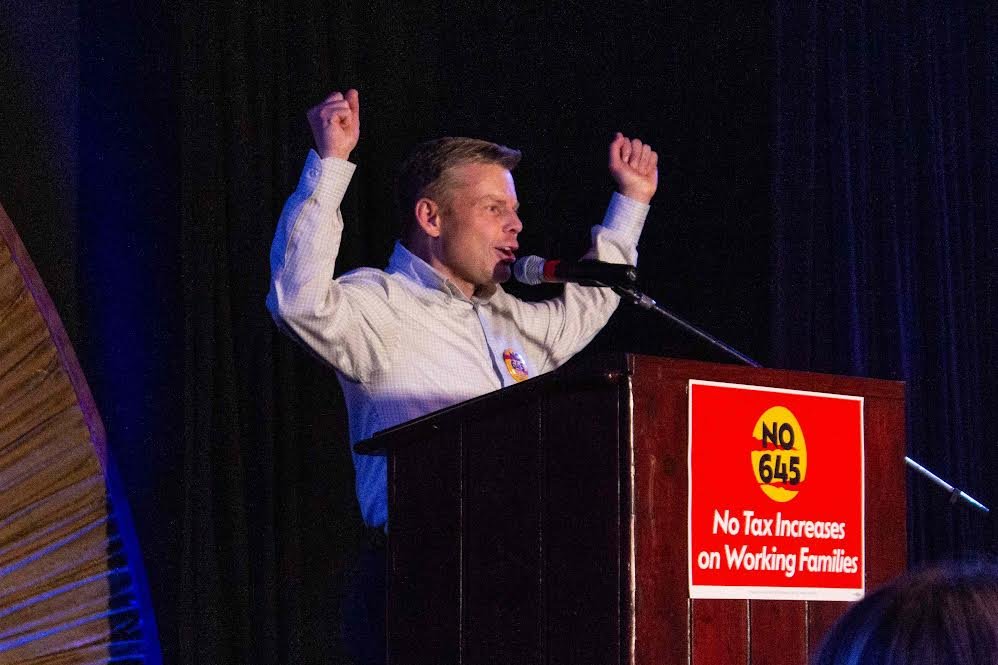
“Washingtonians understood one thing, we’re not going to give tax breaks to millionaires when we can use those dollars to make life more affordable for working families all across the state,” Ferguson told a crowd at a gathering hosted by the No on 645 campaign.
It also will be a legacy success for Senate Majority Leader Jamie Pedersen, D-Seattle, an original architect of the tax, who withstood slings and arrows of opponents as he led efforts to massage the content to secure votes up to the final days of session.
“We have been saddled with an anchor around our neck, with a tax system that is bad for working people, that’s bad for small businesses, that’s bad for just about everybody except for the one percent,” Pedersen said at the event in Seattle.
Erik Houser, spokesman for the No on 645 campaign, called the victory “momentous. But there is still more work to do. Defeating I-645 will avoid deep future budget cuts, but in the near term, until the Millionaires Tax is in place, there will still be very difficult decisions ahead in the upcoming legislative session for the governor and legislators.”
It is a hard loss for Let’s Go Washington, the conservative political committee founded and funded by hedge fund manager Brian Heywood. His group launched a massive signature-gathering drive to get the initiative on the ballot after the Legislature blocked voters’ ability to erase it with a referendum.
“If the income tax doesn’t get repealed, for the next two years, every job creator that leaves this state, every entrepreneur who doesn’t set up shop in Washington, every employee who is concerned that tax will be lowered to them, that is on Governor Ferguson. This is his income tax,” Heywood said Tuesday night.
Washington voters have been asked 11 times over nearly a century to approve personal or corporate income taxes. The first vote, in 1932, was successful. But a 5-4 state Supreme Court decision in 1933 struck the measure down. Later measures failed, most recently in 2010 when the income thresholds were $200,000 for individuals and $400,000 for joint filers.
The income tax is a 9.9% tax on individual and household wage income above $1 million a year. The state’s chief economist estimates the income tax will generate $3.5 billion from 25,000 filers in 2029, the first year of collections.
In addition to the ballot battle, there’s a pending lawsuit challenging the constitutionality of the tax. That case has effectively been on hold to see what voters do. Ferguson, a former three-term state attorney general, has consistently expressed confidence that courts would uphold the levy.
Just two years ago, Let’s Go Washington, the conservative political committee behind Initiative 645, qualified an initiative barring the state and local governments from taxing income. The Legislature adopted the measure only to set it aside earlier this year to allow for this income tax.
Washington’s tax system has long been considered among the most regressive in the country, meaning lower earners pay proportionally more of their income in taxes than wealthier households. This is largely due to the state’s heavy reliance on sales taxes and the lack of an income tax, according to policy experts.
Until this year, Washington was one of only nine states nationwide that did not tax individual wage and salary income.
The disputed income tax was created by Senate Bill 6346, which the Legislature passed in March. It takes effect Jan. 1, 2028. The first dollars would start to arrive in 2029.
Only a few paragraphs in the 110-page piece of legislation actually concern the income tax. Most of the text deals with how the money will be spent.
For example, the new law eliminates sales tax on diapers, personal hygiene products like soap and toothpaste, and some over-the-counter drugs. It also will repeal sales and use taxes for retail services, except advertising services, and expand a tax credit program for lower-income families. All this would happen in 2029 and the costs are to be covered from income tax collections.
Initiative 645 sought to repeal the income tax while preserving those elements.
Initiative foes forecast near ruination of the state’s social safety net and its ability to care for the most in need should those tax collections not materialize. They say the situation is already challenging with federal support for Medicaid and a host of social services getting cut.
They predicted the Legislature and governor would be forced to make deep cuts in all areas of state government to make ends meet.
Backers of the initiative countered that critics were trying to scare voters. They said because the first dollars would not arrive until 2029, the governor and lawmakers had time to find other ways to pay for the new commitments, or abandon them.
The potential for the income threshold to drop below $1 million was an ongoing flashpoint.
Pro-initiative forces argued throughout the campaign that Democratic lawmakers would eventually levy the tax on households earning far less than $1 million because they will need the money. “Everybody knows it’s coming to that,” Heywood said at a forum last month.
Late in the campaign, I-645 backers asserted retirees would see their pensions taxed because the law removed a prohibition on taxing pensions.
Ferguson has repeatedly vowed to veto any legislation that would lower the threshold.
The No on 645 campaign reported spending nearly $12.7 million as of Monday. Its biggest donors are the Service Employees International Union ($3.5 million), Washington Education Association ($3 million), Washington Federation of State Employees ($2.5 million), and National Education Association ($1 million).
Supporters had two primary committees pushing for passage of the initiative.
One was Let’s Go Washington, which raised and spent more than $4 million. That sum included expenses to qualify the measure and separate initiatives concerning a ban on transgender girls’ participation in girls sports and parents rights.
The other committee was Vote Yes Repeal the Income Tax which reported $3.4 million in spending as of Monday. Lawrence Hughes, a retired businessman, is the largest donor at $750,000.
This story was updated at 10:20 p.m. on Nov. 3 with comments from Gov. Bob Ferguson and state Sen. Jamie Pedersen.
Washington State Standard is part of States Newsroom, a nonprofit news network supported by grants and a coalition of donors as a 501c(3) public charity. Washington State Standard maintains editorial independence. Contact Editor Sean Robinson for questions: info@washingtonstatestandard.com.