

by Shaanth Nanguneri, Washington State Standard
June 4, 2026
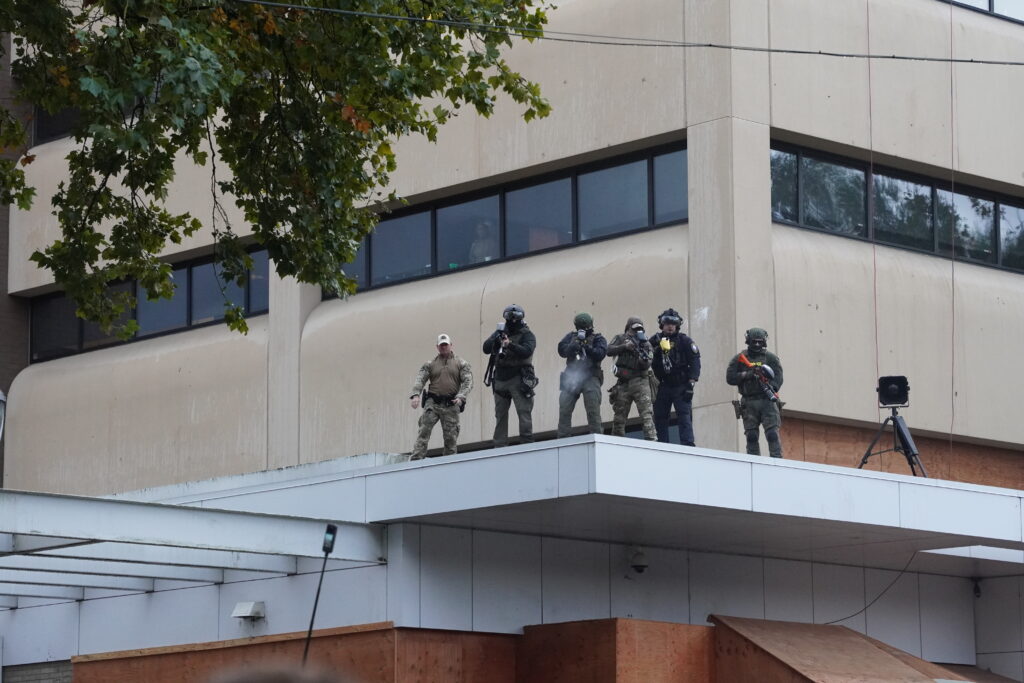
Despite passing some of the nation’s first laws barring federal law enforcement agents from concealing their identities, Oregon and Washington have yet to receive the same response from the Trump administration as other Democratic states.
The U.S. Department of Justice sued California last year over a law criminalizing the use of masks by federal and local law enforcement, winning a federal court order blocking that policy in February. The Trump administration also sued New Jersey and Connecticut in recent months seeking to strike down similar laws, which have gained traction in state legislatures nationwide amid concern about aggressive instances of federal immigration enforcement with little accountability.
But the administration has yet to challenge similar laws in two Northwest states, even though Oregon Gov. Tina Kotek and Washington Gov. Bob Ferguson signed those measures into law weeks before Connecticut Gov. Ned Lamont signed his state’s mask law.
Some legal observers say the timeline is a function of how Oregon’s and Washington’s laws are designed to be enforced and a reflection that they don’t pose an immediate threat to hampering the federal government’s actions. Both states also fall under the jurisdiction of the 9th Circuit Court of Appeals, where the federal government recently scored a key legal victory that has cast doubt on the future viability of state mask laws targeting federal agents. They also both rely upon civil suits to enforce their bans on facial coverings.
“Once the ground is clear on the criminal provisions, I’m sure we’ll see the federal government turn to the civil (penalties),” said Hector Villagra, vice president of policy advocacy and community education at the Mexican American Legal Defense and Educational Fund, at a virtual conference hosted by the left-leaning Prosecutors Alliance Action last month. “I would imagine that the prime target is going to be the criminal because they are a much greater deterrent to this behavior.”
The U.S. Department of Justice did not respond to inquiries about its legal strategy or timeline. But in its recent lawsuit against Connecticut, federal attorneys have asserted that the state’s criminal penalties for agents wearing a mask violate the U.S. Constitution’s supremacy clause, which holds that federal law supersedes conflicting state laws and has granted federal agents significant criminal immunity for decades in court.
Deputy Assistant Secretary Lauren Bis previously told the Capital Chronicle that the Homeland Security Department “will not abide by unconstitutional bans.”
“The supremacy clause makes it clear that state politicians do not control federal law enforcement,” Bis said.
9th Circuit key to broader strategy
An April ruling from the 9th Circuit Court of Appeals halting California’s law requiring federal, state and local law enforcement to display their agency and name or badge number in most circumstances has been key to the administration’s continued legal strategy. Judge Jacqueline H. Nguyen, a President Barack Obama appointee, joined Judges Mark J. Bennett and Daniel P. Collins, both Trump appointees, in ruling that the law violates the U.S. Constitution’s supremacy clause.
“The supremacy clause prohibits states from enacting a law that directly regulates federal operations even if the law regulates state operations in the same manner,” Bennett wrote in the panel’s 16-page decision.
But Villagra was skeptical that the 9th Circuit decision marked a definitive end to pursuing state-level criminal accountability for federal agents. The ruling still leaves the door open to criminal prosecutions based on other state laws, which he said was potentially “the only viable path the court has left.”
“We do have laws that make it illegal now for anyone to wear a disguise or a mask in the commission of a crime,” Villagra said. “It would be interesting to see if a state would be willing to either use one of those laws to prosecute a ICE officer who’s masked, can’t be identified and engages in assault, battery or false arrest, or if a state were inclined to maybe make amendments to a law like that to more specifically cater to these sorts of situations.”
In the meantime, Oregon Democrats who backed this year’s mask law say they are closely watching the courts.
Oregon’s mask and identification law gave law enforcement agencies operating in the state 180 days to adopt public policies that generally prohibit masking, outside of medical exemptions or instances such as an undercover investigation. It empowers Oregonians to seek court orders against agencies that fail to adopt or follow such policies. Washington’s law, meanwhile, encourages people to file lawsuits against individual officers in their official capacity if they fail to provide identification such as a name or badge number when wearing a mask and detaining them.
“The Legislature was very deliberate in the way they approached federal overreach legislation last session, knowing that for any law we pass to make a difference for Oregonians, it must be able to withstand legal challenges,” Jill Bakken, a spokesperson for Oregon House Speaker Julie Fahey, D-Eugene, said in a statement. “With (Oregon’s law) in particular, legislators took lessons learned from other states — particularly California — to draft a bill with the best chance of surviving a challenge in court.”
This story was originally produced by Oregon Capital Chronicle, which is part of States Newsroom, a nonprofit news network which includes Washington State Standard, and is supported by grants and a coalition of donors as a 501c(3) public charity.
Washington State Standard is part of States Newsroom, a nonprofit news network supported by grants and a coalition of donors as a 501c(3) public charity. Washington State Standard maintains editorial independence. Contact Editor Bill Lucia for questions: info@washingtonstatestandard.com.