

by Jake Goldstein-Street, Washington State Standard
April 3, 2026
Washington sued the online prediction market platform Kalshi last week with claims that the company is violating state gambling laws.
Now, one of Kalshi’s partners is biting back.
Robinhood this week sued the state to preemptively protect its ability to continue offering shares in the outcome of everything from sporting events to politics and entertainment news.
The California-based company believes federal statute preempts Washington gambling law. The state prohibits internet gambling, with an exception for bets placed on tribal lands.
Robinhood says the lawsuit is meant to protect access for its customers.
“We believe in the power of prediction markets and the important role they play at the intersection of trading, news, economics, politics, culture, and sports,” a company spokesperson said. “Every eligible customer should have access to these markets, which are federally regulated.”
The attorney general’s office didn’t immediately respond to a request for comment on the litigation.
These prediction markets have emerged in recent years as a way for people to speculate on all kinds of future events, but have drawn heavy scrutiny over whether they align with state gambling laws. Kalshi faces numerous lawsuits like Washington’s. Courts across the country have been split on the legal arguments.
Arizona’s attorney general has even filed criminal charges against Kalshi.
The federal government has gotten involved in the back-and-forth. The federal Commodity Futures Trading Commission filed lawsuits Thursday against Arizona, Illinois, and Connecticut over the states’ actions against prediction market operators, claiming federal law preempts them, as Robinhood is arguing here.
“The CFTC will continue to safeguard its exclusive regulatory authority over these markets and defend market participants against overzealous state regulators,” commission Chairman Michael Selig said in a statement.
Robinhood is registered with the commission, which regulates these “futures contracts.” The company has previously drawn attention for offering low-barrier stock market access.
There are also concerns about users capitalizing on insider information to wager on future events that they already know the outcome of.
Federal lawmakers are eyeing regulations. Bipartisan legislation introduced in Congress last month would ban platforms like Kalshi from offering wagers on sporting events.
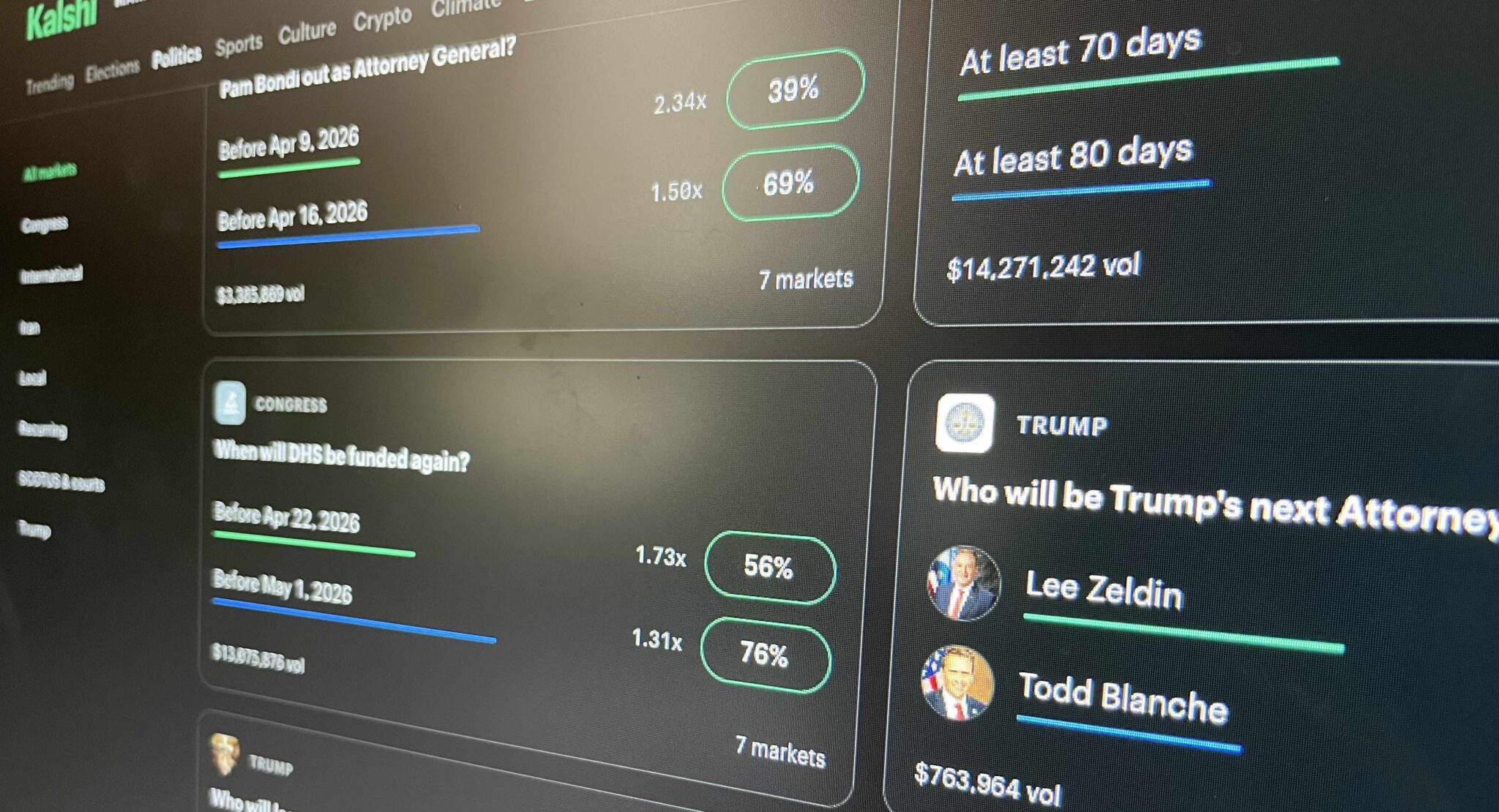
Kalshi offers wagers on a wide variety of events.
For example, users can put money on the daily high temperature in various cities, gas prices and when vessel traffic at the Strait of Hormuz will reopen amid the war in Iran. Earlier this year, they could place wagers on whether Washington would adopt the income tax on millionaire earners. Kalshi and Polymarket run the largest of these platforms.
Robinhood offers wagers on its platform via partnerships with multiple exchanges, including Kalshi’s, according to the lawsuit. It plans to soon offer wagers on another market it partially controls.
The lawsuit, filed in federal court in Tacoma, names the members of the state Gambling Commission and Attorney General Nick Brown as defendants.
In December, the Gambling Commission issued guidance saying that “offering events-based contracts or participating in these markets is not authorized in Washington State.”
“We will continue to monitor the ongoing cases as they progress through the court system and will provide updates once the courts provide further guidance,” the guidance continued.
Robinhood argues its wagering operation is fundamentally different from the sportsbooks that have cropped up at tribal casinos in Washington in recent years. For one, the prices are set by the users who can adjust their position after placing wagers, while bettors at sportsbooks are betting directly against the casino and can’t change their bets after placing them, according to the lawsuit.
In his lawsuit against Kalshi, Brown disagrees.
“They claim to offer a financial product, but Kalshi is just a bookie with a fancy name,” he said in a press conference announcing the suit.
The state’s complaint also notes Kalshi does get involved in trading on its platform.
The company pairs up users choosing opposite outcomes, taking a transaction fee from both. But if there aren’t enough people participating, Kalshi can use its own affiliate to place wagers, so users don’t know if they’re betting against another person or the company, according to the state’s suit.
The lawsuit against Kalshi seeks a judge’s order to halt the company’s operations in Washington, recover money residents have lost and assess civil penalties. Kalshi didn’t respond to a request for comment. Brown initially filed the suit in King County Superior Court, but it’s been moved to federal court in Seattle.
Robinhood took a similar approach last year in Massachusetts, suing the state after the attorney general there filed suit against Kalshi.
Neither the Kalshi or Robinhood cases have court hearings scheduled.
Washington lawmakers this year expanded state gambling law to allow betting on sporting events involving colleges based in the state, like the University of Washington, Gonzaga University and Washington State University. These bets are only allowed at tribal casinos in the state. Prop bets on individual performance are prohibited.
Washington State Standard is part of States Newsroom, a nonprofit news network supported by grants and a coalition of donors as a 501c(3) public charity. Washington State Standard maintains editorial independence. Contact Editor Bill Lucia for questions: info@washingtonstatestandard.com.