

by Jerry Cornfield, Washington State Standard
March 6, 2026
Democrats in the Washington state House on Friday stood at the precipice of enacting a statewide income tax, a momentous political accomplishment for progressives that is expected to face tests in court and on the ballot.
They released a much-anticipated overhaul of the so-called “millionaires’ tax,” with changes to drive more money into early learning programs, increase assistance for lower-income families, and eliminate sales tax on a greater number of consumer products.
The revised proposal also exempts public schools from paying a new sales tax on services and ditches funding for public defense in local courts statewide.
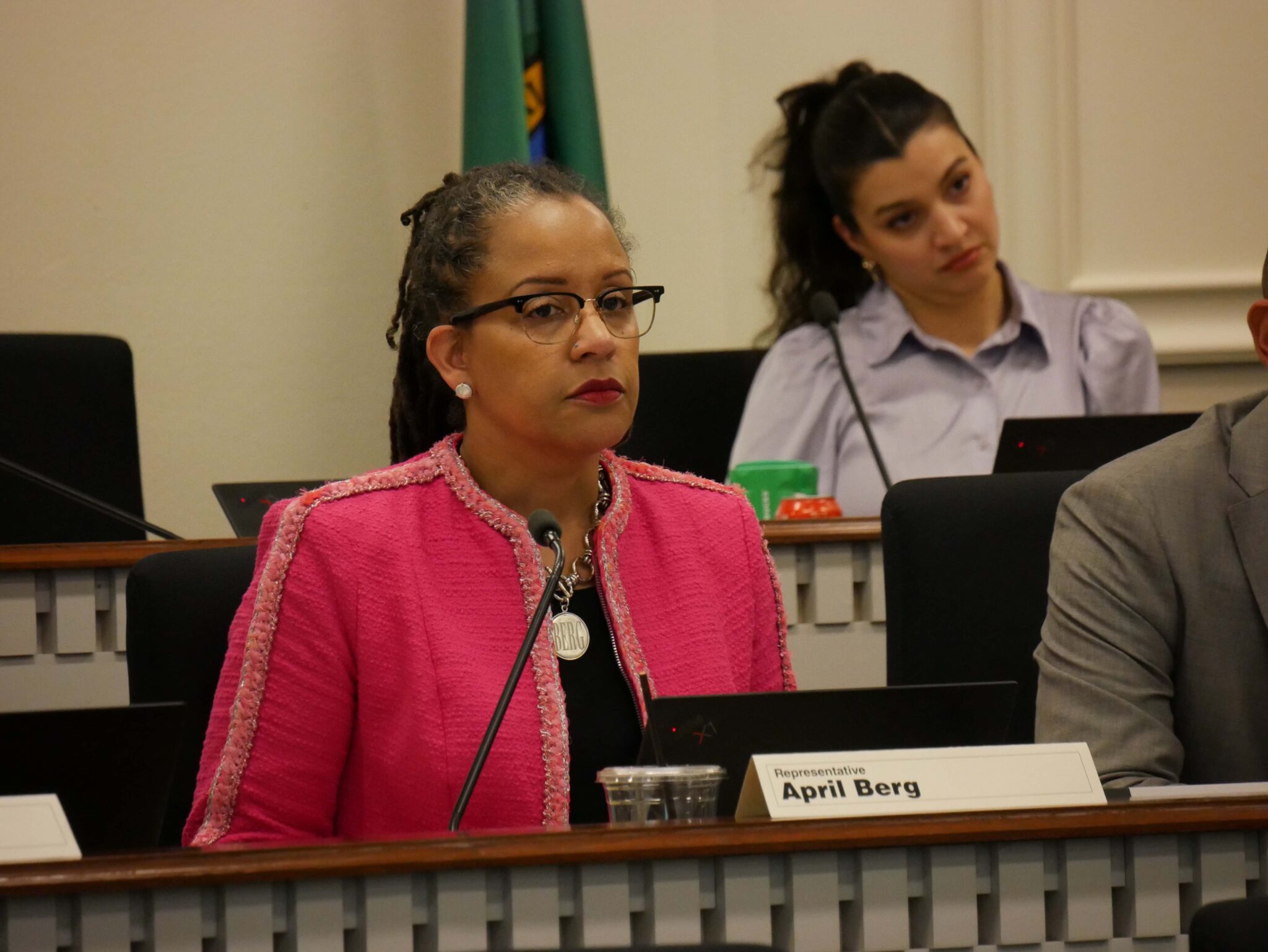
“What you see before you is truly historic legislation to right-size our tax code and make life more affordable for Washingtonians,” said Rep. April Berg, D-Mill Creek, who as chair of the House Finance Committee spearheaded the effort.
Gov. Bob Ferguson heaped praise on the 107-page rewrite of Senate Bill 6346 and pledged to sign it. Included is a further expansion of a tax credit for lower-income families and a boost in tax relief for small businesses, two items he’s demanded be linked to the new tax.
Another big change earmarks 5% of annual tax proceeds for the state’s Fair Start for Kids Act that promotes access and provides resources to support early learning programs and subsidized child care.
“I strongly encourage the Legislature to pass this bill,” Ferguson said in a statement. “It represents a historic step forward in rebalancing our unfair system and making life more affordable for Washington families and small business owners.”
Ferguson’s embrace of the latest iteration comes after his icier response to earlier versions of the controversial legislation, which would impose a new 9.9% tax on household income over $1 million a year.
He’s been at odds with Democratic lawmakers over how much of the estimated $3 billion a year it would generate is spent on tax relief for working families and tax credits for small businesses. Collections from the tax would begin in 2029.
On Tuesday, Ferguson warned that, absent an agreement on ideas he’d pushed for, he would wait until 2027 to finalize the consequential policy. A number of House Democrats were withholding support because of concerns the bill did not do enough for families on the economic margins.
House Majority Leader Joe Fitzgibbon, D-West Seattle, chief sponsor of the tax bill in the House, acknowledged they had to overcome a few significant hurdles the last few days.
“We still have more work to do. We think the mood about the proposal is more positive than it’s been,” he said, adding the “goal” is to pass it Monday.
If successful, it would be sent to the Senate to concur in the revisions. Time is short as the session ends next Thursday, March 12.
The bill contains language to prevent a referendum, thereby forcing opponents to pursue the taller task of qualifying an initiative for the ballot.
Debate in the House could grind on for hours as Republicans “ferociously oppose an income tax, period,” said Rep. Travis Couture, R-Allyn, the lead GOP budget writer.
“Our caucus views this income tax bill as the biggest thing ever. It is a generational shift and a seismic change in our tax system,” he said. “If you were going to put up the most epic fight of your lifetime in this place, it would be over this.”
Signs of dissolving skepticism
As it stands, Washington is one of nine states without an income tax on personal wages and salaries. Opponents argue the tax isn’t allowed under the state Constitution, pointing to a 1933 state Supreme Court ruling.
Washington voters have been asked multiple times to adopt a state personal income tax. Only once, in 1932, was the idea successful. That measure was ruled unconstitutional by the Supreme Court on a 5-4 decision the following year. Voters last considered an income tax measure in 2010 and rejected it by a margin of 64% to 36%.
Two years ago, the Legislature overwhelmingly approved Initiative 2111, banning new statewide personal income taxes. This year’s bill carves out an exemption from that prohibition.
The linchpin of the legislation is its proposed 9.9% levy on adjusted gross household income above $1 million a year. It would take effect Jan. 1, 2028, with tax payments due from an estimated 21,000 filers starting in 2029. The threshold would be adjusted for inflation every two years.
The tax itself has never been the main point of contention among Democrats. The strife has centered on how much of the $3 billion in projected proceeds to lock up for tax relief and credits, and how much to dump into the operating budget to pay for an array of services and programs.
With the latest draft, one large chunk is pledged to expand the state’s Working Families Tax Credit to cover people who are at least 18 years old, and make other eligibility revisions to open the program to more people. As proposed, it is estimated the credits, which range from $50 to $1,330 a year, would be available to 810,000 households, up from the current 350,000.
Another significant decision was to commit 5% of annual tax proceeds — as much as $150 million a year — to Fair Start for Kids. Starting in 2029, this would shore up financial support for child care and early learning programs facing cuts in the current budget.
Rep. Debra Entenman, D-Kent, said this is what she needed to see to cast her vote for the income tax.
“I have gone from ‘no’ to ‘maybe’ to ‘yes,’” she said Friday. Based on the latest version, she said she thinks other holdouts like herself “will be in support of the millionaires’ tax” because it will help families with their basic needs.
Breaking down the tax breaks
Companies grossing less than $300,000 a year will be exempt from paying the state’s main business tax. Ferguson had said he wanted the tax effectively wiped out for the first $2.5 million of businesses’ total revenue.
Under a new provision, starting July 1, public schools and educational service districts would be exempt from paying a new state sales tax on services on live presentations as well as temporary staffing, investigative and security services.
The bill would repeal most retail sales taxes lawmakers adopted last year on services on Jan. 1, 2029. A tax on advertising services that drew a lawsuit from cable giant Comcast would remain in place.
Sales tax for grooming and hygiene products, like shampoo and deodorant, and diapers are eliminated. A provision added Friday would also exempt “certain over the counter drugs.”
Berg used the analogy of a grocery cart to explain how removing the sales tax on those everyday items will help families.
“People kind of poo-poo it. But I’m taking that cart down the aisle and I’m grabbing my shampoo, I’m grabbing my deodorant, I’m grabbing my lotion. My cart is getting fuller and fuller, and all of the items in there are tax-free,” she said. “Depending on where you live, that’s a 10% discount.
In other parts of the legislation, Democrats retain the charitable deduction of $100,000 but require donations be made to Washington nonprofits to qualify. Visiting professional and collegiate athletes and performers will be subject to the tax, but the bill exempts nonresidents who earn income for fewer than five days of work in Washington.
Good intentions vs. concrete commitments
Also heavily massaged in the new version is the opening section, where Democrats spell out the purpose of the legislation and what they intend for it to accomplish. Spanning three-and-a-half pages, it is filled with aspirational ideas and nonbinding pledges — such as free school lunches for public school students.
Ferguson said he was “especially pleased” funding for school lunches was included — except that it is not in any concrete way.
Similarly, there’s a vow to create a new account to help cities and counties deal with the millions of dollars they stand to lose when the sales tax exemptions and repeal of the sales tax on services take effect. But it isn’t created nor money provided in the bill.
Berg and Fitzgibbon said funding will show up in the 2029-31 budget — $280 million for school lunches and $400 million for local governments. That will be part of supplemental budget documents due out next week.
Gone from the bill is a commitment to shoulder more of the costs of providing defense services for those accused of crimes who are unable to afford a lawyer.
The state Supreme Court last year ordered reductions in public defender caseloads, a move that will require local governments to hire not only more lawyers but also judges and other court employees. They don’t have the money.
Originally, the income tax bill locked in 7% of collections to help cover this expense. It was whittled down to $150 million annually, then zeroed out on Friday. City and county leaders had been bracing for this brush-off.
“I made the case very strongly to legislators and the governor on the need for public defense funding,” Pierce County Executive Ryan Mello said late Thursday. “This is a significant unfunded mandate and the state must deal with it, or it is going to break our criminal justice system.”
Because Senate Bill 6346 is one of the most complex tax policies enacted in recent years, the bill would also establish an advisory council of tax experts, lawyers and lawmakers to monitor the development and rollout.
Washington State Standard is part of States Newsroom, a nonprofit news network supported by grants and a coalition of donors as a 501c(3) public charity. Washington State Standard maintains editorial independence. Contact Editor Bill Lucia for questions: info@washingtonstatestandard.com.