
by Jake Goldstein-Street, Washington State Standard
May 6, 2026
WOODINVILLE — For four straight years, at least parts of Washington have been in a drought, as snowpack has failed to meet historical norms amid climate change.
This year, all of Washington is experiencing drought, after a wet winter scuttled by warmer temperatures, according to state officials.
Washington state leaders are looking for ways to deal with the ongoing water challenges, which state Ecology Director Casey Sixkiller calls “our new normal.”
A new initiative, called Washington’s Water Future, will lead roundtable discussions across the state this summer, with recommendations delivered to Gov. Bob Ferguson before the 2027 legislative session begins in January. Local and tribal governments, utilities, industry leaders, environmental groups and community organizations will be at the table.
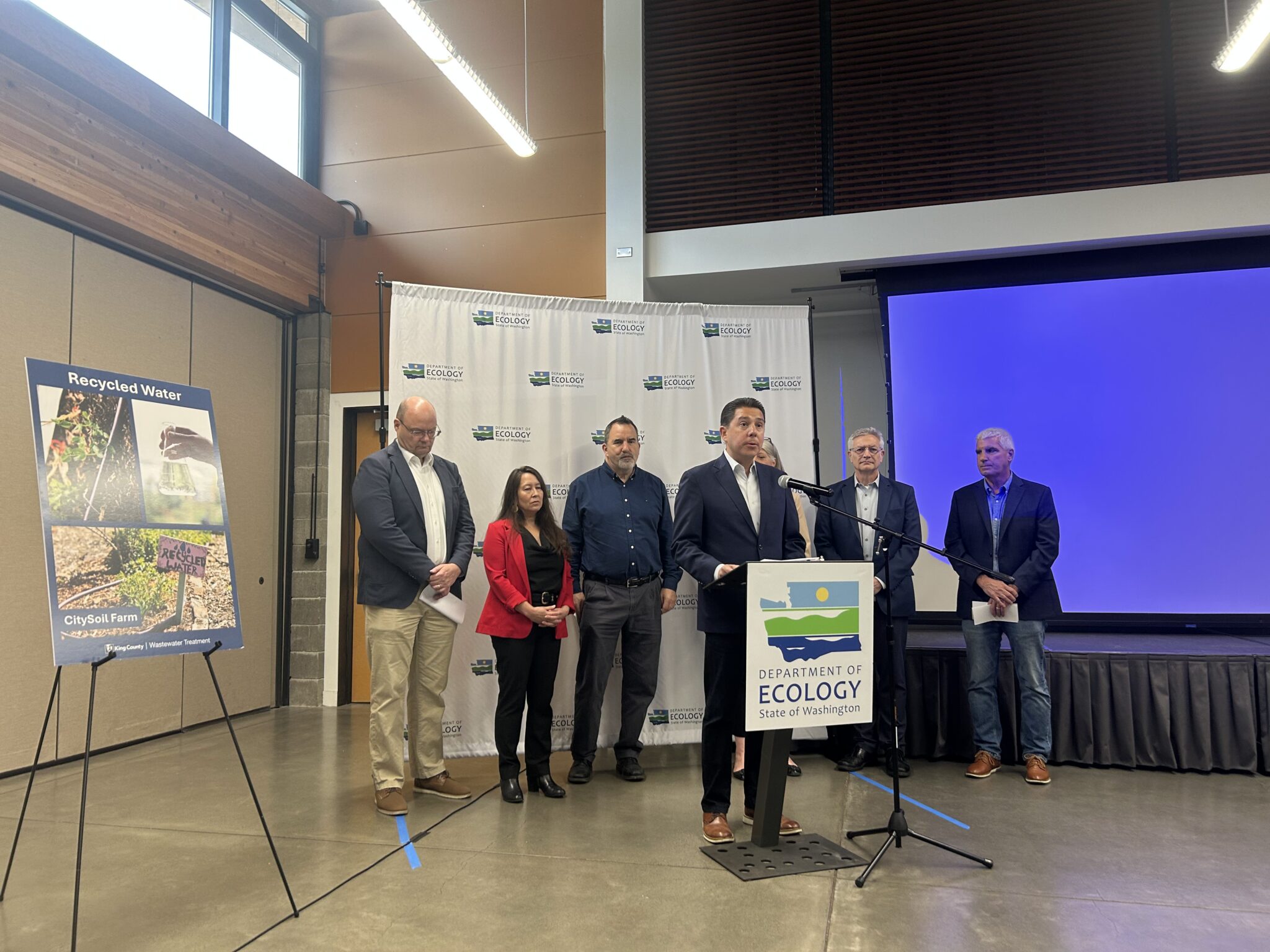
Officials announced the effort Wednesday at King County’s Brightwater Treatment Plant near Woodinville.
“It’s clear we need to take steps to protect our water supply,” Ferguson said in a pre-recorded video. “We need secure water supplies so we can grow our economy, support our agriculture industry, protect healthy fish runs and preserve tribal resources.”
Sixkiller said the work is about whether Washington will shape the future of water in the state, or just react to it.
“Washington is a water state,” Sixkiller said. “Water shapes our landscapes, our communities, our economy, and for many a way of life passed down through generations. We all know that where there’s water, there’s life, but these days, we don’t have to look very hard to see that our relationship with water is changing.”
Climate change is causing precipitation in the winter to fall more as rain than snow, with less stored naturally in the mountains for the summer, when farms and fish are competing for the dwindling resource. This system, dependent on snowpack, is becoming less reliable, Sixkiller said.
By 2080, the Puget Sound region is expected to get less than half of its normal snowpack, with wintertime stream flows increasing by half and a corresponding drop in the summertime, the agency director said.
“The cost of inaction is already showing up in drought emergencies, flood damage, stressed salmon runs and uncertainty for communities trying to plan their future,” Sixkiller said.
Last year, the Department of Ecology took the unprecedented step to curtail surface water usage in the Yakima River Basin, where the effects of drought are more severe. The move has drawn accusations of mismanagement against the state.
In an interview, Sixkiller said it’s too soon to say whether his agency will need to do the same this year, but noted the state declared a drought earlier than usual to give water managers in the area more time to prepare.
The statewide drought declaration last month unlocked $3 million in grants to respond to the effects.
The harms already
The Yakima-Tieton Irrigation District, which serves 28,000 acres, is bracing for its canal system to “blow out” after a wildfire burned it in 2024, and subsequent flooding and debris slides further damaged it, said Jon DeVaney, president of the Washington State Tree Fruit Association.
“This is a clear example of the need to, not only plan long term, but be prepared to see that hole that we’re already in get a little bit deeper,” DeVaney said.
The low flows and higher temperatures are treacherous for Washington’s salmon. And fish hatcheries are grappling with dwindling water. The Suquamish Tribe, for example, hasn’t been able to expand a hatchery because of the lack of water, Chairman Leonard Forsman said.
Forsman, also president of the Affiliated Tribes of Northwest Indians, acknowledged the priorities when thinking about the future of water availability are “people and farms, and then fish habitat comes in later.”
“And we need to try to balance that,” he said.
Meanwhile, data centers the tech sector is building to support artificial intelligence and other technologies are also driving demand for water.
Some of the ideas
In responding to the state’s water needs, Sixkiller said “all solutions and all ideas are on the table.”
He was responding to a question about desalination, a process turning salt water into potable water that communities in more arid climates have turned to in addressing water shortages. Arizona, for one, is pursuing the idea. Sixkiller called the water scarcity in the American southwest a “very big red flag of what could happen here.”
The city of Lynden in Whatcom County has grown rapidly over the past 15 years, Mayor Scott Korthuis said. So the city, located along the Nooksack River, has had to find innovative approaches to securing water.
For one, the city now recycles discharged water from the local Darigold dairy plant into the river, as a source of drinking water.
The city is also working on an aquifer recharge project to take water from the river during high flows and store it underground until it’s needed later. Sixkiller cited this type of work as an idea to be explored in the Washington’s Water Future roundtable discussions.
“There are a range of untapped solutions from different areas, from different ways to store water and to recycling,” Korthuis said, noting financial, legal and regulatory obstacles.
Aging water infrastructure that will need to be replaced or upgraded provides an opportunity for innovative solutions, Sixkiller said.
King County Councilmember Claudia Balducci noted the new initiative’s acronym matches that of the World Wrestling Federation, saying there will be some “smackdowns” in these discussions. The tongue-in-cheek comment worried state Rep. Davina Duerr, D-Bothell.
“I’m afraid it’ll be a smackdown on the Legislature for funding, and whatever else,” she said.
YOU MAKE OUR WORK POSSIBLE.
Washington State Standard is part of States Newsroom, a nonprofit news network supported by grants and a coalition of donors as a 501c(3) public charity. Washington State Standard maintains editorial independence. Contact Editor Bill Lucia for questions: info@washingtonstatestandard.com.