
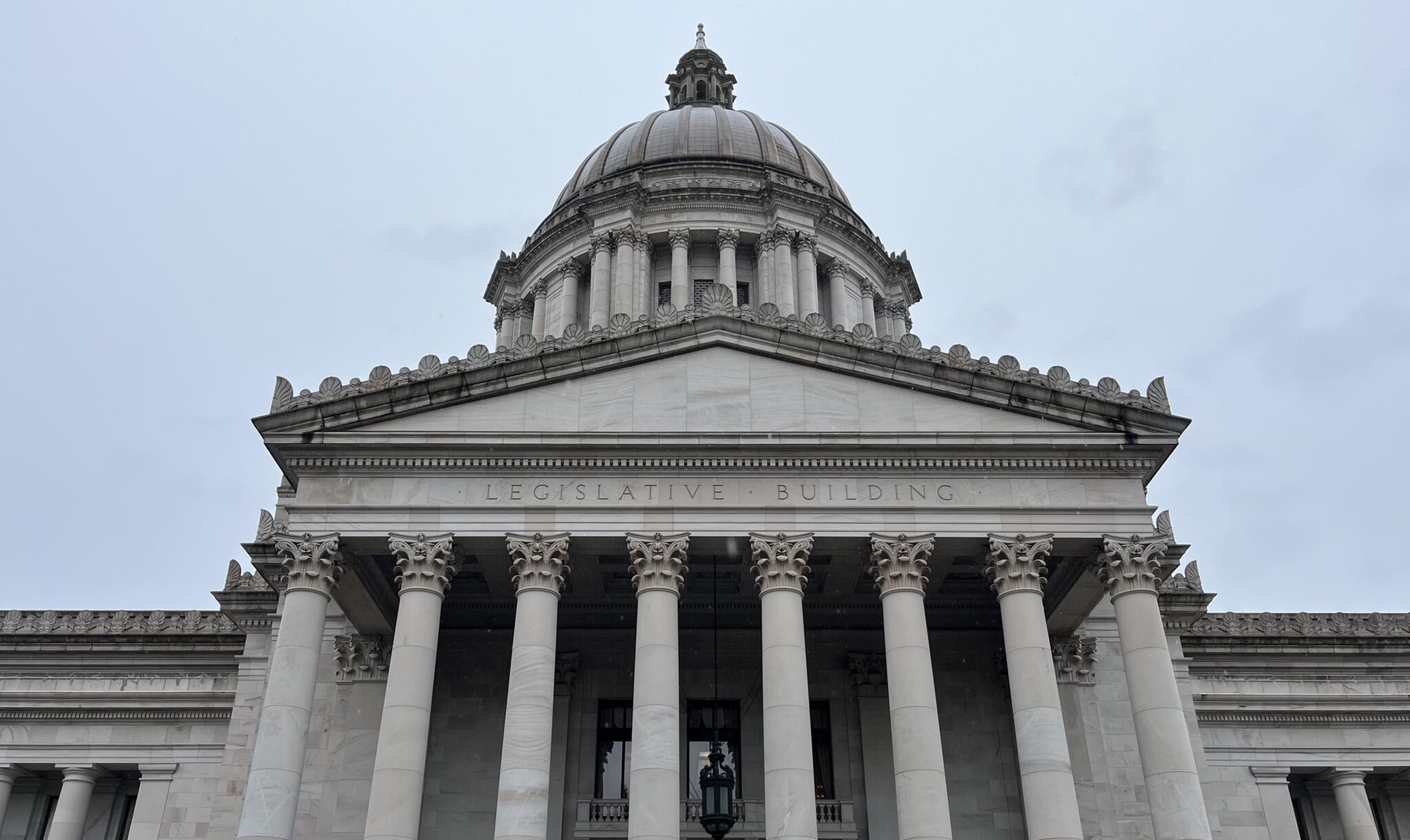

by Aspen Ford, Washington State Standard
March 22, 2026
With just three more sessions scheduled before state law mandates greenhouse gas emissions in Washington be at least 45% below 1990 levels, lawmakers took this year to close polluter loopholes in the state’s climate laws and advance a major bill to upgrade and expand the electrical grid.
Data centers were also a huge draw this session. They are expected to become the largest source of electricity demand in the Pacific Northwest. Lawmakers pressed to regulate them in order to meet climate goals and prevent data center-inflicted hikes for other utility ratepayers.
A sweeping regulatory measure focused on the facilities ultimately failed in the Senate. But under a different bill, the state will require independent facilities that feed power to data centers to conform with a law setting emissions reduction targets.
Attempts to regulate textile waste and increase recycling of bottles and cans failed to pass, but lawmakers intend to continue to work on those policies in the future.
Bills that passed
Establishing a transmission authority
One of the most notable energy bills to pass this year was Senate Bill 6355, which will establish the state’s own electrical transmission authority.
As new technology like data centers and electric vehicles plug in, some energy forecasts predict blackouts in coming years due to grid strain. The idea of the bill is to change that trajectory.
The bill “really allows Washington to play a more active role in building the infrastructure that the state needs to actually deliver on the climate goals that it has set as law,” said Emily Moore, a senior director for Sightline’s climate and energy program. “Without more grid capacity… we won’t be able to wind down our reliance on polluting natural gas and coal.”
Washington will have the power to construct and manage its own grid infrastructure, independent of the Bonneville Power Administration. The BPA, a power wholesaler under the U.S. Department of Energy, owns 75% of the Pacific Northwest’s grid and has no legal responsibility to help fulfill the state’s climate commitments.
Getting the state more involved in the electrical grid will be a slow process. With permitting and other bureaucratic layers, transmission lines can take a decade or longer to see through.
The authority will include a nine-person board. It will prioritize financing partnerships with utilities and other developers to pay for the transmission line expansion. One board member will be a citizen of a federally recognized tribe with ceded lands in Washington.
Sponsored by Sen. Victoria Hunt, D-Issaquah, the authority’s targets include: improving grid reliability during extreme weather events, achieving clean energy standards and maintaining affordable energy rates.
Closing a Clean Energy Transformation Act loophole
Senate Bill 5982 requires port utility districts and other independent electricity generators to comply with the Clean Energy Transformation Act, which mandates that Washington’s electricity supply be completely free of greenhouse gas emissions by 2045.
The legislation, also sponsored by Hunt, was a recommendation from the Washington Data Center Workgroup.
“Currently, large data centers can bypass CETA by operating as boutique utilities or procuring independent power,” Julian Santos, climate and clean energy senior manager for Washington Conservation Action, said during the bill’s first hearing. “This bill ensures that these high-intensity users meet the same clean energy standards.”
Republicans argued that by broadening the scope of the clean energy law, Washington will become a less competitive state for businesses to invest in.
“How are we going to expand our tax base if we are not investing in economic development? Data centers do just that,” said Rep. Stephanie Barnard, R-Pasco, before the House floor vote.
The bill passed along party lines in both chambers, with Democrats in support.
Establishing stricter standards for fuel suppliers
The state’s highest source of greenhouse gas emissions comes from the transportation sector.
House Bill 2215 will lower the carbon emissions threshold for fuel suppliers to be covered by the state’s Climate Commitment Act. It would drop from 25,000 metric tons to 500 metric tons.
Opponents argued that the bill disproportionately burdens small local businesses, such as propane suppliers in rural areas, when the Climate Commitment Act was intended to regulate large polluters.
But bill sponsor Rep. Joe Fitzgibbon, D-Seattle, said there have been cases where large fuel companies have created smaller limited liability corporations to bypass paying for the state’s carbon emissions requirements.
“I, more than anything, see this as a fairness bill,” he said during the bill’s first hearing. “Those fuel suppliers that have been following the law – they shouldn’t be undercut by competitors who are looking for loopholes.”
Reducing no-cost carbon allowances
Emissions-Intensive Trade-Exposed facilities include oil refineries and paper, aerospace and metals manufacturers that have not been required to pay for their own carbon allowances under the Climate Commitment Act. This is because these industries are considered to be facing significant market competition.
Sponsored by Sen. Vandana Slatter, D-Bellevue, Senate Bill 6246 will change state law to slowly cut down the no-cost allowances it gives each year up until 2035. These industries will be required to report detailed emissions information and prepare for long-term reductions.
The measure is “really important for the integrity of the CCA,” said James Hove, Washington director of Climate Solutions.
A break for the Spokane incinerator
Spokane’s Waste to Energy facility, which burns the city’s trash to generate electricity, will now have a longer timeline to reduce greenhouse gas emissions. The facility is the only one of its kind on the West Coast and powers around 13,000 homes in Spokane.
In order to comply with the Climate Commitment Act, the incinerator was required to meet clean energy requirements by next year, which the facility wasn’t prepared to do. Instead, it would have paid anywhere from $4 million to $8 million in carbon allowances, which would have increased electricity rates, according to Spokane Mayor Lisa Brown.
House Bill 2416 will require the Department of Ecology to allocate no-cost allowances to the facility from 2027 to 2030 as it continues to plan out how to reduce its emissions.
Bills that failed
Data center regulations
House Bill 2515, the sweeping set of data center regulations aimed at protecting the grid and offsetting rate hikes, made traction in the Legislature, but stalled in the Senate Ways and Means committee.
Sponsored by Rep. Beth Doglio, D-Olympia, the measure would have required utilities to establish a policy for charging data centers they serve to prevent rate hikes for other customers.
It would also have mandated that the centers switch to emissions-free power by 2045, aligning with the state’s Clean Energy Transformation Act. And, data centers would have had to share a yearly sustainability report, water and energy use data and server cooling technology information.
Doglio said she intends to bring the bill back next year.
Bottle and can recycling
House Bill 1607 would have required a 10-cent deposit when purchasing most bottles and cans. That 10 cents would have been refunded back when those containers were dropped off at recycling locations.
To do so, it would have required beverage companies to form a producer responsibility organization, which would have funded the initial implementation of the program and would have submitted annual performance reports to the Department of Ecology.
Opponents argued the bill acts as a tax on Washington residents, and that dropping off bottles and cans would be burdensome when Washington offers curbside recycling.
The measure, sponsored by Rep. Monica Stonier, D-Vancouver, did not advance to a House floor vote.
“It was our organization’s number one priority,” said Heather Trim, executive director of Zero Waste Washington. “Washington has been a leader in reducing waste, and especially plastic pollution, and we look forward to a vigorous discussion of this bill and others next year.”
Textile recycling and reuse
With the rise of so-called fast fashion social media trends, Rep. Kristine Reeves, D-Federal Way, sought to build out the infrastructure to create a circular economy for textile waste.
House Bill 1420 would have established a statewide producer responsibility organization for textile waste. An amendment slimmed down the measure to only mandate a study of how a regulatory program would be implemented, but even that didn’t pass.
If the full version of the bill had been approved, Washington would have been the second state in the country to enact such legislation, following California.
The legislation did not receive a vote in the House Appropriations Committee. Reeves said she intends to keep working on the bill.
Washington State Standard is part of States Newsroom, a nonprofit news network supported by grants and a coalition of donors as a 501c(3) public charity. Washington State Standard maintains editorial independence. Contact Editor Bill Lucia for questions: info@washingtonstatestandard.com.