

by Jerry Cornfield, Washington State Standard
September 17, 2026
The state Supreme Court on Thursday delivered the final blow to a controversial 2024 ballot measure pushed by builders and passed by voters that sought to halt Washington’s shift away from natural gas.
In a 6-3 decision, the justices affirmed a lower court ruling, finding Initiative 2066 “unconstitutional in its entirety” because it runs afoul of a provision limiting such citizen initiatives to no more than one subject.
Chief Justice Debra Stephens, writing for the majority, said the initiative violated the single-subject rule by including “several provisions with markedly distinct purposes and regulatory effects. It is not possible by judicial construction to sever and save any of the separate provisions and therefore I-2066 is unconstitutional in its entirety.”
Justice Sal Mungia, in his dissent, didn’t fully disagree. He identified sections that he would have struck because they “silently amend the law” in a way that voters could not understand their impact. But he would have upheld the rest of the initiative.
“Courts are required to construe initiatives in favor of constitutionality when possible. This court can uphold much of I-2066 as constitutional and should do so,” Mungia wrote in a dissent joined by Justices Sheryl Gordon McCloud and Charles Johnson.
The initiative filled 21 pages and contained more than a dozen sections. Some of those dealt with unwinding changes to the state energy code that offer builders incentives in the permitting process for choosing electric heat pumps – which provide both heating and cooling in the same unit – instead of natural gas furnaces.
Other provisions sought to repeal parts of a 2024 state law intended to accelerate Puget Sound Energy’s transition away from natural gas. The measure also would have prevented approval of utility rate plans that would end or restrict access to natural gas, or make it too costly, and would have erased some zero-emission goals from state law.
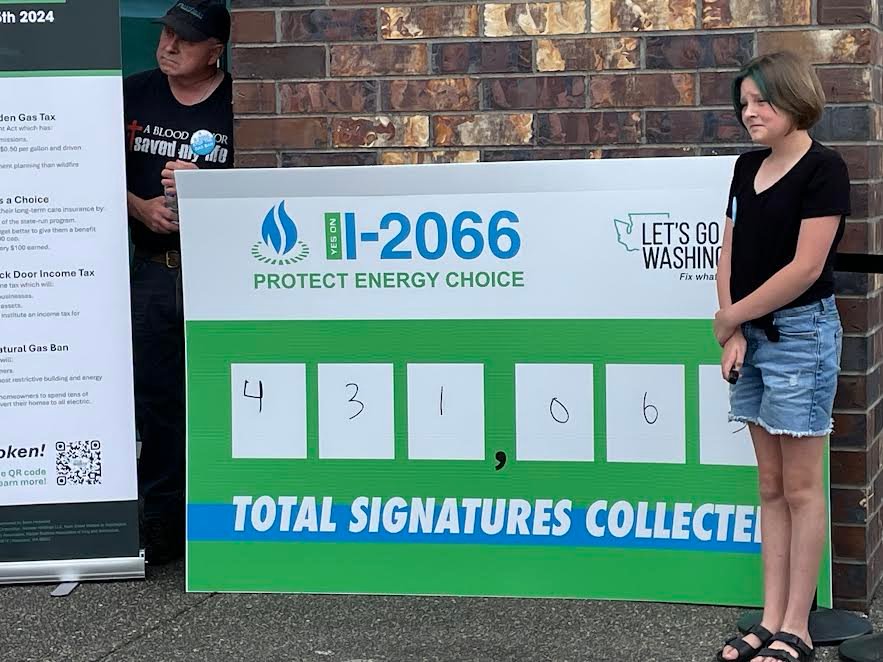
The Building Industry Association of Washington drew up the measure and enlisted Let’s Go Washington, a conservative political committee, to gather signatures to get it on the ballot.
Nearly 52% of voters approved it as it passed in 34 of Washington’s 39 counties including Snohomish and Pierce.
But it never took effect. Within days of the certification of the 2024 election, a coalition including Climate Solutions, Washington Conservation Action, Front and Centered, King County and the city of Seattle sued.
Its attorneys argued then that the measure’s “most obvious constitutional infirmity” was that it violated the prohibition on what is known as “logrolling.” This is a practice in which an unpopular policy is attached to a popular one to increase its likelihood of enactment.
In March 2025, a King County Superior Court judge agreed and struck down the law.
“What a win for Washington families in keeping our energy affordable and clean,” said Gregg Small, executive director of Climate Solutions. “And we welcome this timely ruling in support of clearer, more honest information on how initiatives impact our lives and communities.”
Greg Lane, the building association’s executive vice president, said dejectedly, “This is the end of the line.”
While this effort may have gained builders some flexibility in codes that was not there before, he said “fundamentally there is still the effective ban on natural gas on all new commercial and residential construction.”
Brian Heywood, founder of Let’s Go Washington, derided the decision as “shameful.”
“Today, Washington’s initiative process is weaker than it was yesterday,” he said in a statement.
“(Voters) made their decision and exercised a constitutional right reserved for the people. Today, that decision was erased by a biased and one-sided court.”
It was a very different mood among environmentalists. They viewed the measure as a sweeping attack on a suite of policies intended to break the state’s reliance on natural gas.
“By upholding the state’s constitution, the Supreme Court has put us back on track to reap the benefits of cheaper, cleaner renewable energy,” said Caitlin Krenn, Washington Conservation Action’s Climate and Clean Energy Director
Former Gov. Jay Inslee, a driving force behind many of the state’s far-reaching climate and clean energy policies, said the decision “prevents a rollback from the ability of Washingtonians to have meaningful ways to get more reasonably priced energy, to get energy that is less polluting, and to maintain our ability to have (energy) efficiency.”
And the initiative process won too, he said.
“We have constitutional safeguards against deceptive initiatives that hide unpopular ideas underneath things that might have majority support,” Inslee said. “The Supreme Court rightfully blew the whistle on that.”
Future ramifications?
From the outset, Lane insisted that “every single section” of the measure addressed the broader policy of protecting consumers’ choice to access and use of natural gas. On Thursday, he said that before writing the initiative, they considered how it lined up with past Supreme Court decisions on the single-subject rule.
He contended Thursday’s ruling represents a new and tougher standard that could derail legislation, past and future.
“I think that the court has really stepped into the legislative process and changed it,” Lane said. “This could mean laws approved by the Legislature won’t hold up.”
Kai Smith, an attorney with Pacifica Law Group, which represented the Climate Solutions-led coalition, didn’t think so.
“Every law, whether passed by the Legislature or through the citizen initiative process, has to comply with the constitution,” he said. “And, today I-2066 does not.”
The case known as Climate Solutions vs. State of Washington/Building Industry Association was argued on Jan. 22.
Washington State Standard is part of States Newsroom, a nonprofit news network supported by grants and a coalition of donors as a 501c(3) public charity. Washington State Standard maintains editorial independence. Contact Editor for questions: info@washingtonstatestandard.com.