

by Steve Stein, Washington State Standard
October 23, 2025
“I often explain it to parents like this: I’m not more entertaining than the latest cat videos or the drama on social media — but I am more exciting than nothing.”
That’s a recent survey response from a teacher in Washington state.
Without the distraction of cellphones, students engage more with their teachers and peers. They use class time to focus on assignments, and teaching feels more like it did when I first started 20 years ago.
Based on what we’re reading in the literature, observing in classrooms, and most importantly, hearing from teachers, the message from educators across Washington is loud and clear: cellphone policies, when paired with consistent enforcement, are making a positive impact. In contrast, weak enforcement leads to poor results.
I observe about 150 high school classrooms a year, bringing a decade of experience, meaning I was in classrooms both before and after the COVID-19 pandemic.
In fall 2024, one classroom stood out. I should say — it grabbed my attention.
Before, during, and after the lesson, students were actively participating and discussing the material. This level of engagement has been rare lately. The teacher attributed the change to a new, strictly enforced policy prohibiting phone use. I thought about that classroom for the entire two-hour drive to my next classroom.
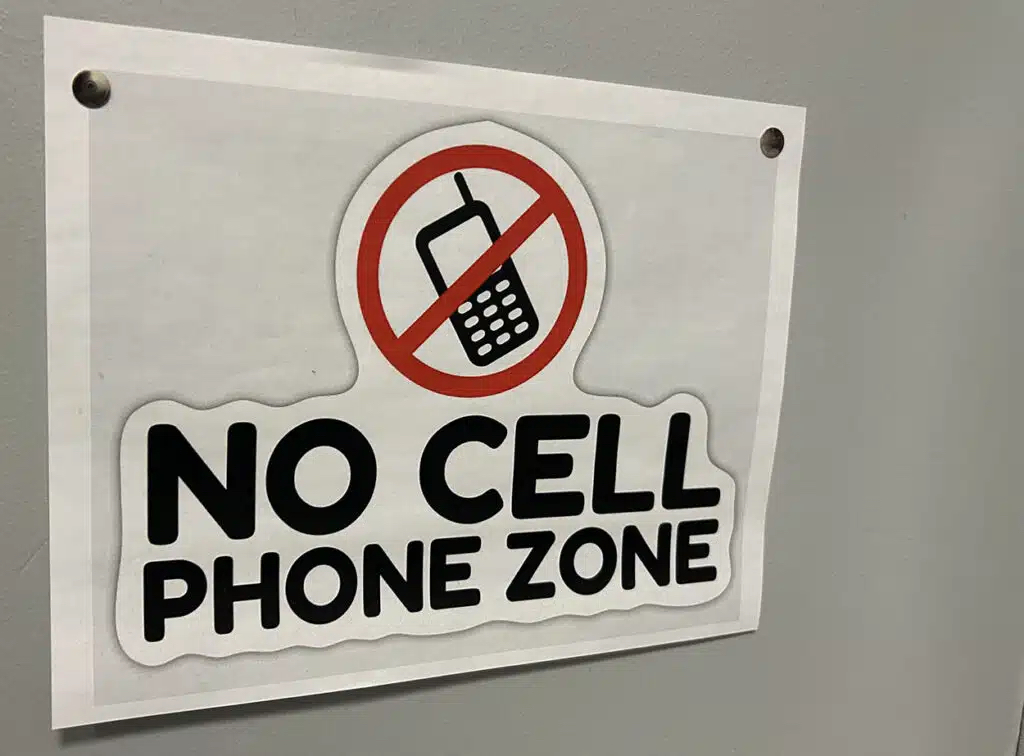
This wasn’t an isolated case. Throughout the fall and winter, I encountered more classrooms with similar energy. Each time, the teacher mentioned a change in cellphone policy. One day, after I left a classroom that shared this same positive environment, I passed a sign in the hallway: “From bell to bell, there is no cell!”
The consensus among these teachers from these classrooms was clear: changing the policy wasn’t difficult. The key was to start the year with a unified commitment from staff to enforce it consistently. Over time, even students began to appreciate the benefits. While my observations are anecdotal, they were compelling.
Calling on survey data for insights
In early spring this year, my colleagues and I surveyed nearly 300 teachers and received 212 responses within a week — a high return rate. Our validity check confirmed four key factors and a moderate reliability score. We used professional statistical software to analyze the data and even submitted open-ended responses to ChatGPT for collation.
The survey revealed a nuanced and often frustrating reality. While many educators report improved student behavior when policies are consistently enforced, inconsistent application, lack of administrative support, and student addiction to devices undermine these efforts.
Teachers also report several obstacles in enforcing phone policies effectively.
One major issue is inconsistent enforcement across staff, which undermines the credibility and effectiveness of the rules. Additionally, many teachers feel a lack of administrative support, making it difficult to uphold policies with authority.
Student defiance, often fueled by phone addiction, presents a daily challenge, as does parental pushback, which can weaken the school’s resolve to maintain strict guidelines.
When phone policies are enforced, teachers reported positive changes such as increased student engagement, more peer interaction, improved social skills, and a stronger classroom presence.
Distractions are minimized, and incidents of cheating are reduced. However, when enforcement is lax, the opposite occurs — students show decreased focus and participation, behavioral issues rise, and the overall learning environment deteriorates.
To address these challenges, teachers who responded to the survey recommended a complete bell-to-bell phone ban, centralized phone storage during class, consistent enforcement by all staff members, and a system of clear, progressive consequences for violations.
A smaller group of teachers advocated for policies allowing teacher discretion for educational use of phones. Even among them, the need for clear guidelines and safeguards against misuse was emphasized.
The survey paints a picture of schools grappling with the pervasive influence of personal technology. While positive change is possible, it requires clear policies and consistent enforcement.
Teachers are calling for a unified approach to create a more focused and engaging learning environment for students. But it’ll take support from administrators and parents for classroom cellphone bans — and the benefits they can offer — to successfully take hold.
Editor’s note: This article was written by Steve Stein, with assistance from Kyle Carrigan, who is director of educational partnerships and outreach at College of the Desert in Palm Desert, California, and Geoff LaBrant, who serves as regional math coordinator for Washington’s Educational Service District 105.
Washington State Standard is part of States Newsroom, a nonprofit news network supported by grants and a coalition of donors as a 501c(3) public charity. Washington State Standard maintains editorial independence. Contact Editor Bill Lucia for questions: info@washingtonstatestandard.com.