

by Donna Gordon Blankinship, Washington State Standard
September 1, 2025
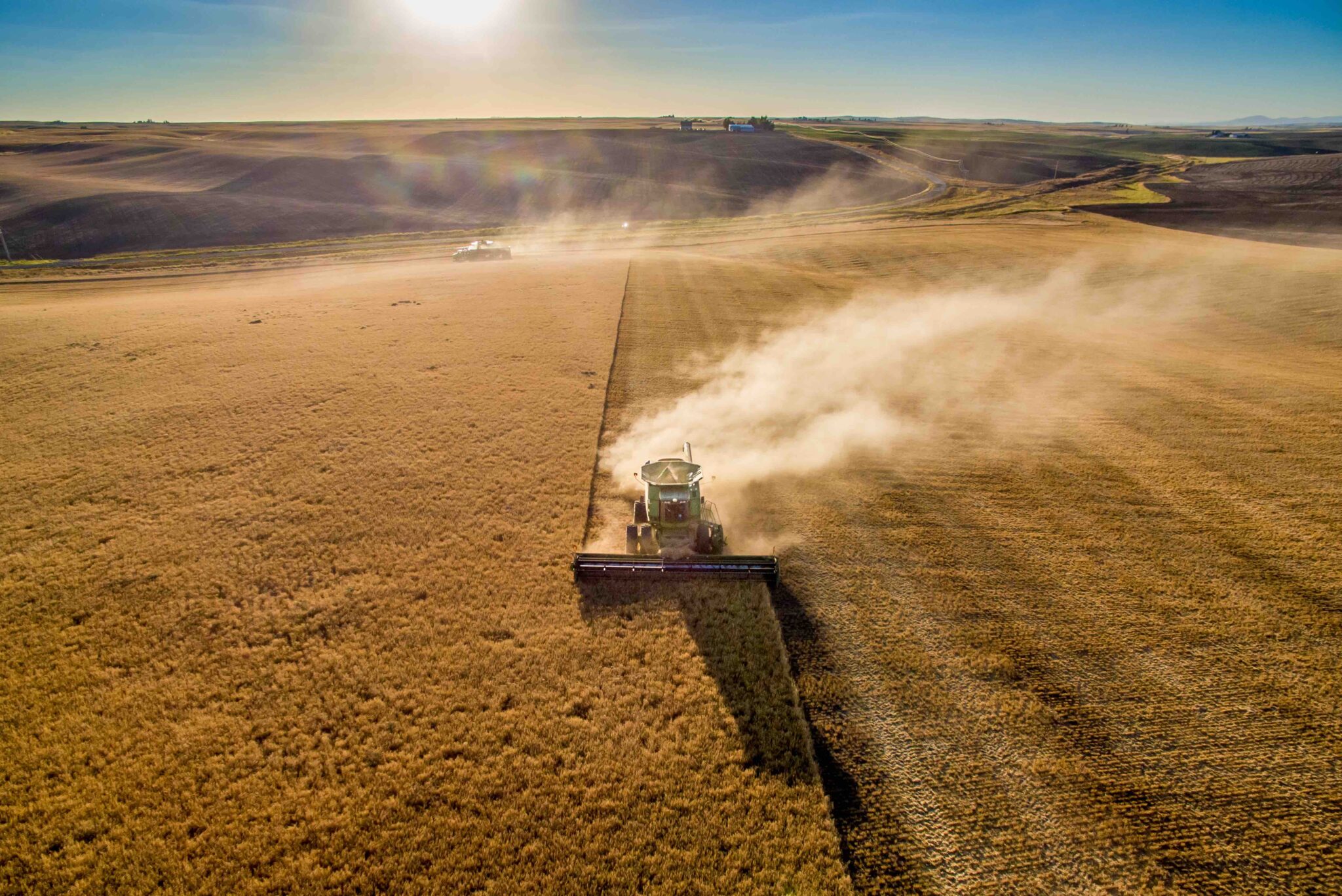
When organic wheat farmer Joel Huesby was growing up in the 1960s and 1970s in southeast Washington, many teens sought jobs in the region’s vegetable canneries. He, his wife, his sister-in-law and many friends all worked in a cannery and then each June joined other teens around Walla Walla picking strawberries.
“It was kind of like a rite of passage,” said Huesby. But while he enjoys reminiscing, he also acknowledges that it would be impractical for today’s farmers to depend on teens and other amateurs to pick their crops.
It was nearly as impractical back in the 1960s when Congress canceled the guest worker program to make room for more American workers in agriculture. The temporary worker program was established during World War I as a solution to labor shortages. The program closed in 1922 but was brought back in 1942, with a focus on Mexican farmworkers spending part of the year in the United States.
It continued to evolve until 1964, when foreign workers made up nearly half the American farm workforce. At that time, Congress shuttered the program and encouraged American youth to be patriotic and work in the fields. And those American teens were about as enthusiastic for agricultural work as the farmers were about hiring them.
“That’s not today’s agriculture,” says Huesby. “You need the people to come onto the big farms … and basically follow the seasons north. That’s a completely different world.”
American agriculture has changed a lot since the mid-20th century. And the challenges farmers face today are different as well. The list is long. In addition to ongoing labor issues, there are stagnant commodity prices, rising equipment and transportation costs, tariffs, unevenly distributed government subsidies and federal programs that stop and start government distribution of surplus crops.
People following politics closely may be focused on the ways Trump administration policies on immigration and tariffs are making life more difficult for farmers. But Washington growers say the main challenges they face go back a lot further than the 2024 election.
‘Our growers are running out of time’
Huesby, who identifies as conservative politically, says American farmers can’t succeed without guest workers and immigrants. He says Americans who grew up in this country are not raised for agricultural jobs.
“They don’t have the work ethic. They’re soft. They don’t have the muscle memory,” he said. Huesby doesn’t hire seasonal workers for his small organic wheat farm, but his neighbors do and they talk.
They worry about what might happen to the current guest worker program and whether farmworkers from Mexico and Central America will continue to come to the United States for seasonal work if they think they could be picked up by U.S. Immigration and Customs Enforcement at a church or the grocery store, even though they are in this country legally.
Washington fruit growers lived with those fears this summer when, thanks to great weather, they saw one of the best cherry crops they’ve had in years.
Mark Powers, president of the Northwest Horticultural Council, said the organization, which works with tree fruit growers, is concerned about the news coming out of the other Washington. But the industry’s No. 1 issue is labor and as it has been for years, he said.
While trade and tariffs both get more attention from the public, labor and regulatory issues have been haunting cherry, apple and pear growers for more than a decade.
“Growers focus on growing excellent fruit. That’s their day job. But increasingly, growers have to wear a lot of different hats,” Powers said.
Those include regulatory compliance, managing guest workers, OSHA and food safety. Escalation in wages and compliance issues at both the federal and state levels apply most of the pressure. Remember those old movies and books that make farming seem like an easygoing, idyllic life? I’m not sure if it ever was, but Powers assures me it certainly isn’t today.
“Every year, the anxiety, the concerns, and now in some cases fear, ratchets up,” Powers said. He adds: There’s no sign on the horizon that rising costs will level off.
He notes that Washington farmworker wages have gone up at least 48% since 2017, but a glance at state income statistics shows that is true for all wages in the state, not just farm wages. While this is a challenge for all employers, most have increased their prices to keep up with rising costs. But Powers and others maintain that isn’t as simple with food and commodity prices.
Apple prices, for example, have not increased 48% since 2017. The Federal Research Bank of St. Louis tracks consumer and commodity prices, and they report that apple prices have risen about 20% during that same time period, with some ups and downs depending on apple varieties and other circumstances like the weather. Just for comparison, the cost to rent an apartment in Seattle went up more than 90% during the past decade.
“People can manage around that to a certain degree for a limited amount of time. Our growers are running out of time,” Powers said.
Domestic labor shortages are adding complexity and cost. More fruit growers are now depending on the H-2A visa program, also known as the guest worker program, for seasonal farmworkers.
Between 2017 and 2024, the number of H-2A workers brought into Washington state increased from approximately 18,800 workers to roughly 36,000. That increases farm labor costs – because farmers have to provide housing and transportation for these guest workers – and total labor expenses are getting out of reach for small family farms, Powers said.
The program may also be making it harder for farmers to attract local workers since they do not have to provide housing for non-migrant labor and there’s a higher hourly wage required for H-2A workers – $19.82, versus the state minimum wage of $16.66. These disparities are also leading to dissatisfaction among the local workers, according to farm labor advocates.
‘If it had been up to the Northwest, we would have had a solution’
The U.S. Department of Agriculture provides money to farmers to keep them in business despite price and expense fluctuations, but the system is considered imperfect by some and unfair by others.
Huesby, the wheat farmer, is not a big fan of farm subsidies. He calls them “subsidized crop insurance,” and notes that 10% of farms get 80% of the subsidies. Part of the reason for the disparity is how complex the government programs are. Only farms that afford someone to do all the extra paperwork can get their hands on this money, he says, noting, “I’m a farmer of the soil. I’m not a farmer of computer programs.”
It doesn’t matter your politics, Huesby says. Both conservative and liberal farmers have something to say about U.S. agriculture subsidies, which most lawmakers are reluctant to cut or reform because farm lobbies in Washington, D.C., are so strong. Huesby, who is not shy about expressing his political views, says this is one of the reasons he thinks congressmen should not turn public service into a lifetime career.
Powers believes both immigration reform and agriculture policy reform could provide some relief. He says both state leaders and central Washington’s representative in Congress, Rep. Dan Newhouse, are working toward solutions.
“If it had been up to the Northwest, we would have had a solution,” Powers said, noting this is a big country with diverse opinions on both topics and that’s one reason why these reforms are taking so long.
Newhouse has proposed several bills to protect American farms and is working with a bipartisan coalition on a proposal to modernize the guest worker program, to provide a steady immigrant workforce for American farms. Washington state lawmakers have been working with agriculture industry leaders to find a way to pay farmworkers a good wage while keeping farmers in business and their crops harvested.
A coalition of farmers and farmworkers are also working together on these challenges. Save Family Farming, based in Everson, Washington, reported earlier this summer during the cherry harvest that the federal immigration crackdown was leaving some farms without the labor they needed to harvest their fruit.
While local workers were worried about being targeted by ICE agents, some migrant workers were also staying away, said Erik Zavala, director of field staff at Wenatchee-based Blue Bird, Inc., a cooperative of small family farms. They heard on social media that farmworkers were warning the migrants to avoid Washington because ICE was conducting raids at orchards.
No actual raids were reported by Washington farmers, but the fear was enough to keep workers away.
Fear is a major factor in many of the threats affecting Pacific Northwest agriculture. For example, Washington fruit growers export 25-30% of their crop and the threat of rising tariffs and the uncertainty surrounding Trump’s trade wars have added to farmers’ uncertainty. Tariffs may eventually affect equipment costs and parts to repair equipment – one more thing to worry about.
Growers have started to leave the industry, Powers said.
According to the USDA National Agricultural Statistics Service’s Census of Agriculture, Washington tree farms actively producing a crop decreased by 15 percent between 2017 and 2022. But Powers said that number has gone down since then. The USDA reports the number of Oregon apple farms decreased by 26.6 percent, pear farms by 27 percent, and sweet cherry farms by 28.9 percent between 2017 and 2022.
Huesby wraps up all the challenges facing farmers into six words: “You can’t do business with instability.”
Washington State Standard is part of States Newsroom, a nonprofit news network supported by grants and a coalition of donors as a 501c(3) public charity. Washington State Standard maintains editorial independence. Contact Editor Bill Lucia for questions: info@washingtonstatestandard.com.